
The story behind the workbooks & journals.
Creative Truth Drops brings original artwork, reflective writing and guided questions together, giving you space to explore your own experience.
Follow the eight parts
How an answer becomes useful later.
Always the Strong One explores overgiving, mental load and the role of being the person everyone relies on. You begin by choosing one recurring situation, such as managing family plans, answering late-night messages or taking over unfinished work.
That situation stays with you. Each part looks at it from another angle and gives you something to carry into the next. By the end, the pieces come together in a personal Honest Care Plan.
You can write briefly, pause, skip what does not fit and return when you have more room.
How the eight parts connect.
Explore the route and see what each part adds.
Part 1 of 8
The strong one from the outside
What does the strong role look like from the outside?
Begin with the person others see: capable, dependable and able to keep things moving. Look at what stays out of sight, alongside what you value about being that person.
Strong One Profile
A picture of what people rely on, what you keep hidden, and what the role gives and costs you.
Carry that picture into Part 2, where you look at the load behind the role.
Part 2 of 8
What is already using you up
What is already using me up before anyone asks for more?
Look at the visible tasks and the background load: remembering, anticipating, worrying and managing feelings. Notice which kinds of energy are already running low.
Hidden Load Picture
A clearer account of the visible and invisible load, and the energy it is using.
Part 3 uses this context to follow what happens when another request arrives.
Part 3 of 8
The moment you give past your limit
When do I ignore my first honest answer?
Follow one request through your first reaction, the answer you gave, the immediate relief and the later cost. Look for the point where you went past your own limit.
Overgiving Loop
A sequence that makes your familiar response easier to recognise, including where a different response may be possible.
In Part 4, you explore what makes that familiar answer feel safer than stopping.
Part 4 of 8
Why stopping feels dangerous
Why does stopping feel dangerous?
Explore the beliefs, fears and learned expectations attached to being useful. Consider what the role may have protected and what it asks of you now.
Strong One Rule
Words for the rule beneath the automatic yes, its possible protective role and its present cost.
Part 5 brings this understanding to the responsibilities you are actually carrying.
Part 5 of 8
What is actually yours to carry
What is truly mine to carry?
Sort necessary responsibilities, automatic responsibilities and responsibilities that need support. Consider what could be shared, reduced, delayed or returned, while recognising what genuinely has to stay.
Responsibility Sort
Decisions about what you will carry, what could change and what belongs elsewhere.
Use those decisions in Part 6 to choose a response that fits what you can genuinely offer.
Part 6 of 8
Change the way you care
How can I care without automatically giving everything?
Explore a full yes, a smaller yes, a later time, different help, being the wrong person for a task and a real no. Put the options into your own words and plan one realistic try.
Honest Care Menu
A set of responses you can adapt to your time, energy and responsibilities.
Part 7 makes room for the other side of care: naming what you need and asking what someone else can offer.
Part 7 of 8
When you need care too
What happens when I need care too?
Name the help you need and what makes receiving it difficult. Consider a manageable request, possible sources of support and the other person's capacity to respond.
Receiving and Mutual Capacity Plan
A more specific way to ask, receive and make room for an honest answer.
Part 8 considers the times when support is limited and some responsibilities still cannot be put down.
Part 8 of 8
When you really do have to keep going
What protects me when I genuinely have to keep going?
Protect essentials, consider what could become smaller or less polished, and look for partial relief. Name the signs that more support or a change is needed.
When I Still Have to Carry It Plan
A plan for the responsibilities that remain, the minimum care you need and the support you could request.
Bring the eight outputs together in your Honest Care Plan, then return to the Before I Say Yes check when another request arrives.
A look inside the pages.
See the space for your answers and how one page prepares you for another. These previews are from the US Letter edition.
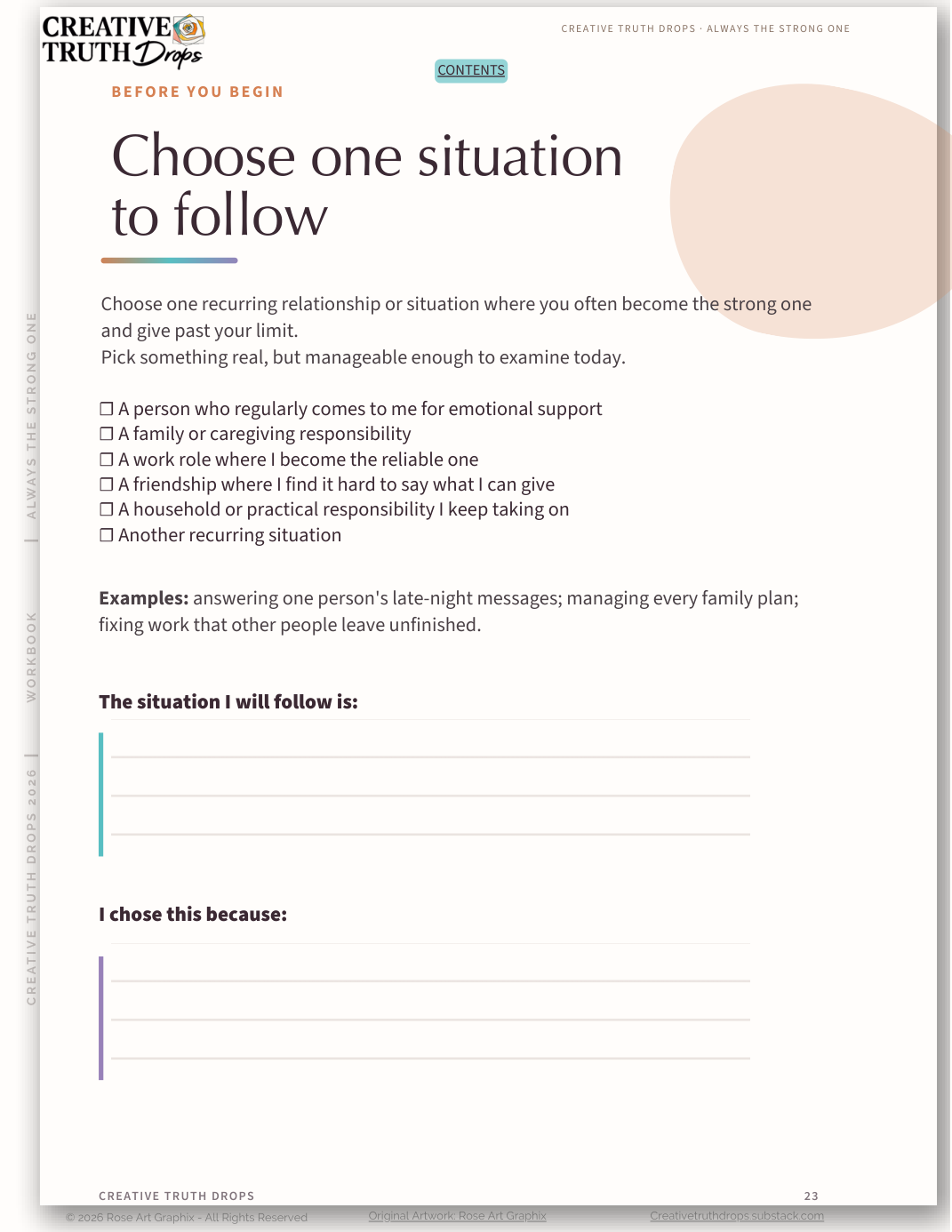
Read this page’s text
Choose one recurring relationship or situation where you often become the strong one and give past your limit. Pick something real, but manageable enough to examine today.
- A person who regularly comes to me for emotional support
- A family or caregiving responsibility
- A work role where I become the reliable one
- A friendship where I find it hard to say what I can give
- A household or practical responsibility I keep taking on
- Another recurring situation
Examples: answering one person's late-night messages; managing every family plan; fixing work that other people leave unfinished.
Lined writing spaces: The situation I will follow is: and I chose this because:
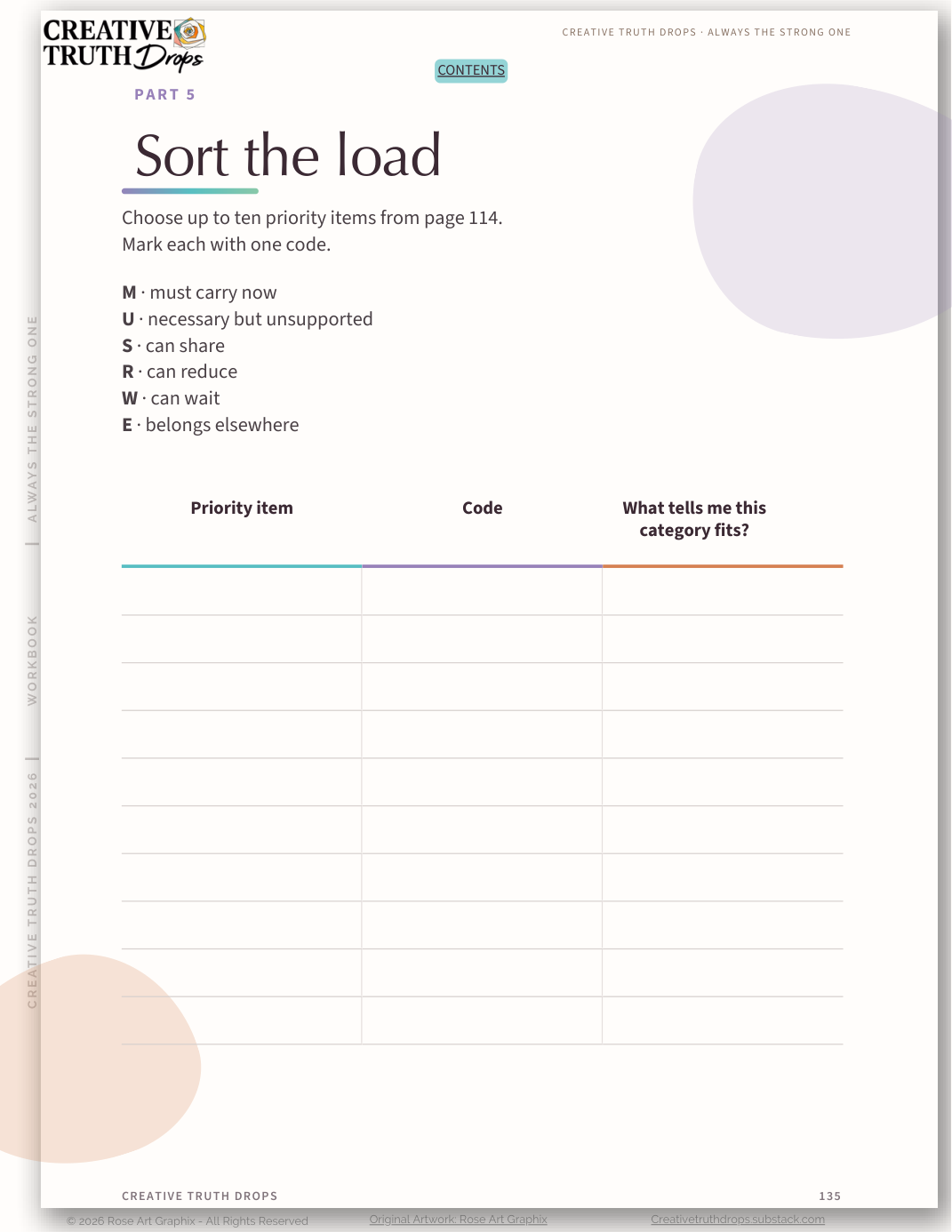
Read this page’s text
Choose up to ten priority items from page 114. Mark each with one code.
- M · must carry now
- U · necessary but unsupported
- S · can share
- R · can reduce
- W · can wait
- E · belongs elsewhere
The blank writing table has ten rows and three columns: Priority item, Code and What tells me this category fits?
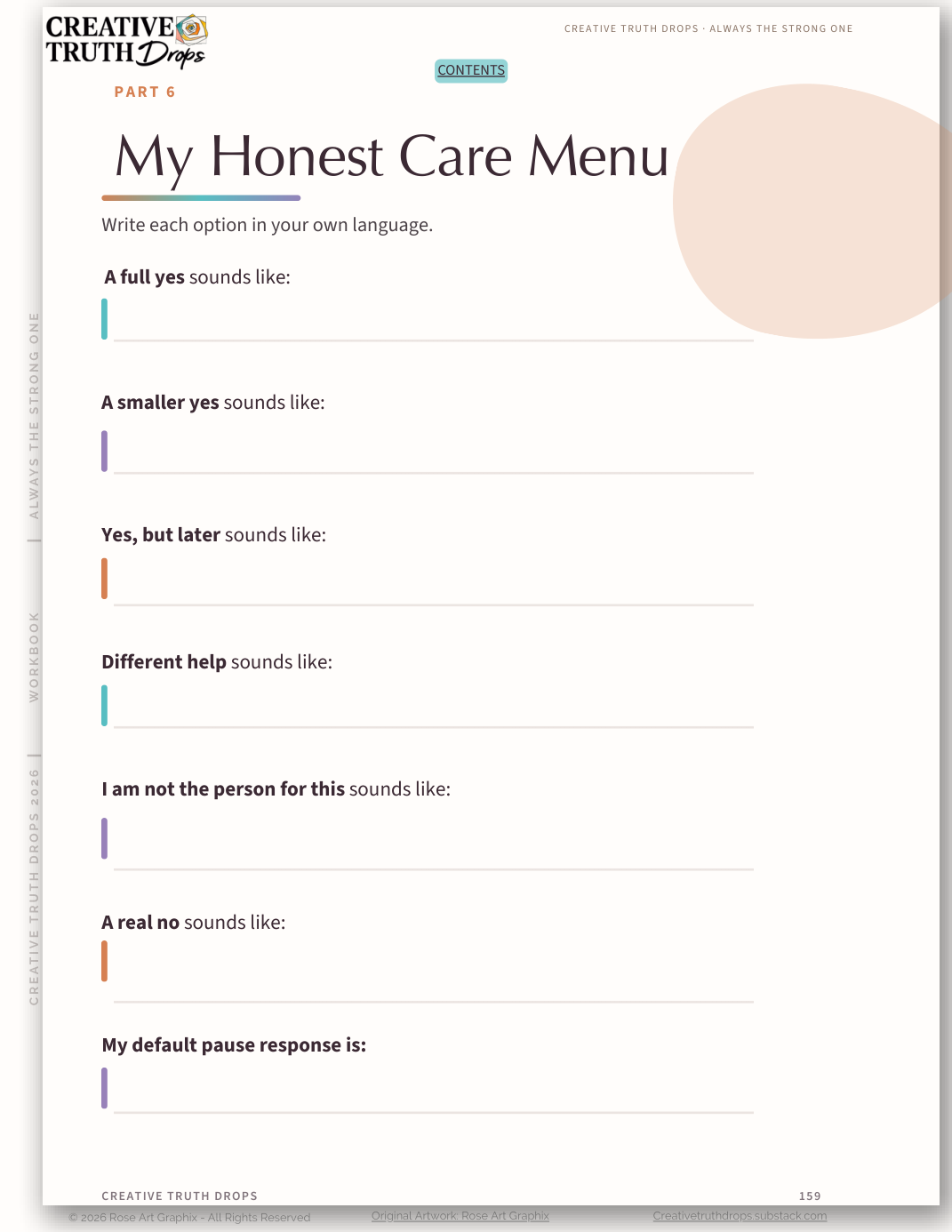
Read this page’s text
Write each option in your own language.
- A full yes sounds like:
- A smaller yes sounds like:
- Yes, but later sounds like:
- Different help sounds like:
- I am not the person for this sounds like:
- A real no sounds like:
- My default pause response is:
Each prompt has its own writing space.
Your Honest Care Plan.
The closing pages bring your eight outputs together. You choose the answers that feel most accurate and useful, then decide what you want to remember before another request arrives.
- What you are carrying and why you keep going past your limit.
- What you can genuinely offer, how much and when.
- What you will change, share or stop taking on automatically.
- What support you need and what protects you when the load has to stay.
A reusable Before I Say Yes check gives you a way to return to those decisions in ordinary life.

Capacity.
The water in Capacity keeps flowing out while very little appears to return. The portrait holds the question of what it costs to keep supporting others when there is little left inside.
The workbook follows that question into real responsibilities, the difficulty of receiving care and the choices that are still available.
Explore the artwork and its meaningRead the related article on SubstackExplore the full workbook.
Always the Strong One is available as a digital PDF in A4 and US Letter. Print it to write by hand, or use it in a PDF annotation app.
For personal reflection and self-discovery. These workbooks do not replace professional mental health care.